


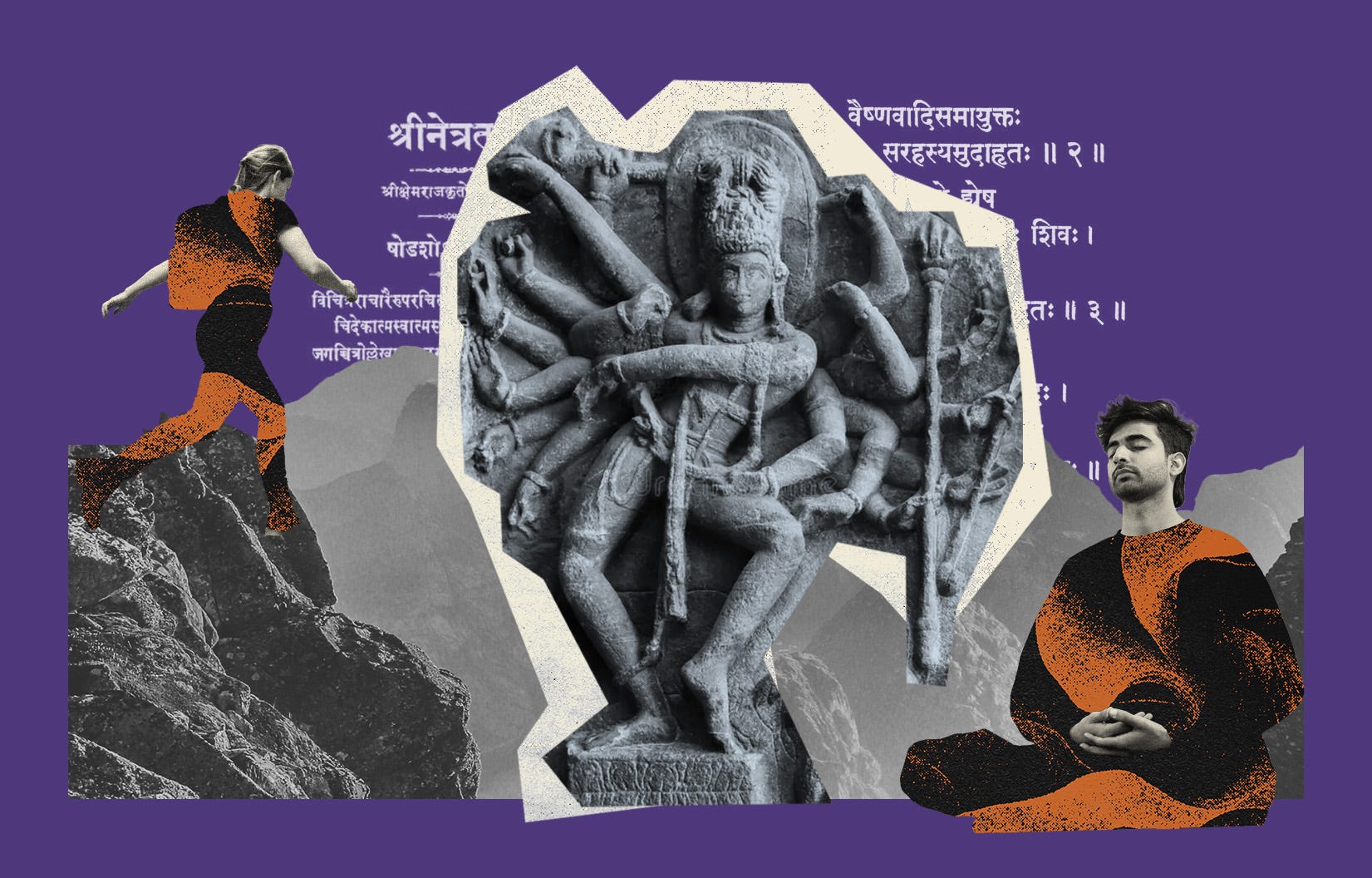
“Pratibhā is that intellectual function (prajñā) of the poet (kavi) whose mind (cetas) is concentrated (stimita) on thinking (cintā) about words (śabda) and meanings (artha) that are appropriate to (anuguṇa) rasas. It arises for a moment (kṣaṇaṁ) from the contact (sparśa) of the poet’s mind with the essential nature (svarūpa) [of the Ātman]. It is that which makes (karoti) the things (bhāva) that abide (vartin) in all the three worlds (trailokya) seem as if (sākṣāt) they were right before our very eyes, and [hence] it is known (gīyate) as the third (tṛtīya) eye (cakṣu) of the Divine [Śiva] (bhagavat).”1
Vyaktiviveka, Bhartṛhari
Pratibhā Beyond Intuition
In the dynamic geography of Indian thought, one of many illuminating concepts is pratibhā, a word that denotes an inner radiance of understanding — a creative intuition that transcends mere ‘surface’ knowledge. In the Tantric tradition, the goddess Parā embodies this creative power: she is the supreme intuition, the divine intelligence that sparks insight in poets, seers, and philosophers alike. To experience pratibhā is to be touched and inspired by her presence — to glimpse an upsurge of meaning before it solidifies into words.
But what exactly is pratibhā? And why has it been so central to Indian thinkers, from the philosopher-linguist Bhartṛhari to the aesthetician and mystic Abhinavagupta? More than just a word for ‘intuition’, pratibhā plays a profound role in Indian theories of language, cognition, and creativity. To explore its significance, let’s turn first to Bhartṛhari, who systematically articulated this principle within his linguistic philosophy, and then to Abhinavagupta, who wove it into the very fabric of aesthetic experience and mystical realization.
“More than just a word for ‘intuition’, pratibhā plays a profound role in Indian theories of language, cognition, and creativity.”
Bhartṛhari and the Creative Power of the Word
Bhartṛhari (5th cent. CE) was a foundational figure in Indian linguistic philosophy, best known for his treatise Vākyapadīya. He argued that language is not merely a tool for communication but is in fact expressive of the very nature of reality itself – what he refers to as śabdabrahman (the ‘absolute as word’). Central to his philosophy is the idea that all speech arises from a deeper, pre-verbal level of cognition. This is where pratibhā functions: as an intuitive grasp of meaning that precedes formal linguistic expression.
For Bhartṛhari, pratibhā is the generative power of language itself. It is the luminous flash of understanding that allows poets and seers to articulate truths that would otherwise remain unspoken. However, it is not simply an individual faculty; it is the very dynamism of life unfolding through and as speech. While the origins of this idea precede Bhartṛhari and can be traced to back to the Upaniṣads and the early Vedic references to Vāk (Speech), he gave it a unique systematic form, distinguishing it as a means of knowledge from perception (pratyakṣa), inference (anumāna), and scriptural testimony (āgama). In Bhartṛhari’s framework, pratibhā is a mode of direct, non-discursive knowing that underlies all forms of expression.
“For Bhartṛhari, pratibhā is the generative power of language itself. It is the luminous flash of understanding that allows poets and seers to articulate truths that would otherwise remain unspoken.”
Abhinavagupta and Pratibhā as Aesthetic and Mystical Insight
In the centuries after Bhartṛhari, the concept of pratibhā took on a unique significance, particularly in the work of Abhinavagupta (10th–11th century CE)2, the great Kashmiri philosopher, aesthetician, and Tantric master. For Abhinavagupta, pratibhā is not only a linguistic faculty but also a spiritual one, synonymous with the goddess of the Supreme Word, Śrī Parā – a Tantricized form of the goddess Sarasvatī. Throughout Abhinavagupta’s corpus, whether it is mentioned in his texts on theatre and poetry, or in his philosophical works, pratibhā evokes a meaning that transcends the everyday experience of intuition. As it is synonymous with the goddess of Speech, pratibhā is a divine dynamism inspiring the hearts of all living beings.
“For Abhinavagupta, pratibhā is not only a linguistic faculty but also a spiritual one, synonymous with the goddess of the Supreme Word, Śrī Parā – a Tantricized form of the goddess Sarasvatī… As it is synonymous with the goddess of Speech, pratibhā is a divine dynamism inspiring the hearts of all living beings.”
Abhinavagupta sees pratibhā as the wellspring of artistic and mystical experience at the same time that it is a universal linguistic force ever-present in all variations of life. It both allows a poet to create verses of deep resonance and a yogi to intuit deeper truths about reality. In both instances, pratibhā bridges the gap between the Absolute and the individual, making it possible for ‘transcendence’ to be expressed in human terms. This dual function of pratibhā — as both a cosmic principle and an individual faculty — is reflected in the Tantric structure of language itself through the doctrine of the “Levels of the Word’ (vāk).
For Bhartṛhari, there are three levels of the Word – Paśyantī (the “visioning word”), Madhyāmā (the “middle word”), and Vaikharī (the “speaking word”). What distinguishes the levels of this hierarchy is relative to how subtle or gross they are – with vaikharī denoting the most manifest/gross level. The most subtle reality level is paśyantī-vāk – which is that level of reality’s linguistic-creative activity that is synonymous with pratibhā. For Abhinavagupta, pratibhā is situated at a 4th reality level – that of the Supreme Word (Parā-vāk) –, which divinizes creativity and meaningfulness by equating pratibhā with the dynamic body of the goddess Parā.
“For the poet (kavi) is like (iva) Prajāpati, from whose desire (kāma) the entire world (jagat) is created (janita). [This poet is] possessed with (śālinaḥ) the power (śākti) to give form (nirmāṇa) to wondrous and diversified (vicitra) meanings (artha) [as well as what is] prior [to meanings] (pūrva). [This power] arises (utthita) from the revealing grace (anugraha) of the goddess (devatā) Parā Vāk, which is another word (abhidhāna) for pratibhā, [that supreme intelligence which] arises (udita) continuously (satata) as the sanctuary (āyatana) of one’s own Heart (svahṛdaya).”3
Abhinavabharati, Abhinavagupta
Whether pratibhā originates from paśyantī or parā, this function ultimately coheres into the madhyamā-vāk (the “middle word” of subtle thoughts and dreams), and finally into the vaikharī-vāk – which is understood both as the fully articulated speech of everyday life and the gross objects of the material world. This process of manifestation from the subtlest source to the gross level of everyday appearances reflects the path of creativity for all beings and indeed for reality itself. Thus, in a culture that typically depicts reason and intuition as separate functions, this theory bridges the two in describing how all reasoning, language, and creative activity arises from a dynamic cosmic imagination that can be simultaneously experienced, articulated, imbibed, and embodied.
“In a culture that typically depicts reason and intuition as separate functions, this theory bridges the two in describing how all reasoning, language, and creative activity arises from a dynamic cosmic imagination that can be simultaneously experienced, articulated, imbibed, and embodied.”
The Poet as Seer: Pratibhā and Aesthetic Experience
In the Indian tradition, the poet (kavi) is not merely a wordsmith but a visionary, someone who perceives reality in its deepest essence. Abhinavagupta affirms this in his commentary (Locana) on Ānandavardhana’s Dhvanyāloka, where he associates pratibhā with the divine inspiration of Sarasvatī, the goddess of speech and wisdom.
“Sarasvatī, [working] within great poets, in pouring forth this sweet matter (arthavastu) [viz., the emotions and flavors] reveals a special, vibrant, genius (pratibhā), which is superhuman.”4
Dhvanyāloka-Locana, Abhinavagupta
The poet’s pratibhā is what enables them to access and ultimately evoke experiences of rasa (the essence of an aesthetic experience) through their work.
The connection between pratibhā and rasa is fundamental to connecting the aesthetic and the philosophical dimensions that comprise Abhinavagupta’s work as a whole. Rasāsvāda is the distilled emotional essence relished by an audience in aesthetic experience. According to Abhinavagupta, this experience mirrors the mystical realization of brahmāsvāda (the relishing of the Absolute). Pratibhā is the catalyst that transforms mere poets, philosophers, and artistic spectators into a sahṛdaya (lit. ‘with heart’) — a refined spiritualized aesthete capable of bridging the finite and the infinite, the mundane and the sublime.
As Hemacandra, the 11th-century poet and philosopher, put it:
“It has been said that there can be no poet who is not (also) a seer. And a man (becomes) a seer because of his “vision” (darśana). Vision is the knowledge of the truth of the nature and properties of various things. A man is said in the śāstra to be a poet only because of vision. A man is said to be a poet in the world when he has both vision and (the power of) description. This is why, although the first poet (Vālmīki) was always gifted with clear vision, as long as he did not actually describe (things) he was not known as a poet (but only as a sage).”5
Kāvyānuśāsana, Hemacandra
For Abhinavagupta, this vision is more than an individual talent; it is a manifestation of Parā’s divine creativity, pouring through the poet as an unbounded flow of inspiration.
Explore the Print and/or Digital Issues of Tarka Journal in our online shop.

Pratibhā as the Highest Power of Consciousness
In his Tantric works, Abhinavagupta goes even further, identifying pratibhā with ultimate reality itself. In the Tantrāloka, he describes it as anuttarā, the highest expression of consciousness, which allows the Absolute to manifest in and as the world. In an important verse, he invokes the goddess Parā as cit-pratibhā, the luminous insight intelligence force of reality itself.
“I praise and extoll (naumi) the Supreme Goddess (devīṃ) Parā, the creative, illuminating power of Consciousness (cit-pratibhāṃ), who is the Yoginī [consort] of Bhairava (bhairava-yoginiīm). [She is enthroned] on a seat (āspada) made (kṛta) of Lotuses (ambuja) [extending from the Trika] Trident (śūla), [the three prongs of which represent] the aspects (aṃśa) [of] the Knower (mātṛ or pramātṛ), the Means of Knowledge (māna or pramāṇa) , and the Known Object (meya or prameya).”6
Tantrāloka, Abhinavagupta
This identification suggests that pratibhā is not just a cognitive faculty but the very power of universal creativity. Thus, whether in poetry, philosophy, or mystical practice, pratibhā is the power that enables the infinite to shine forth in the finite. It is the bridge between transcendence and immanence, the flash of insight that unveils reality in its fullness.
”[This suggests] that pratibhā is not just a cognitive faculty but the very power of universal creativity.”
Conclusion: The Creative Pulse of Reality
Pratibhā, then, is far more than mere intuition. It is the pulsation of creativity at the heart of reality. For Bhartṛhari, it is the inner spark that makes language and the instinct of animals possible; for Abhinavagupta, it is the divine intelligence that fuels both artistic genius and spiritual awakening.
To cultivate pratibhā is to align oneself with this creative power — to participate in the ceaseless unfolding of meaning, beauty, and philosophical discovery. Whether in poetry or philosophy, in speech or silence, it is the radiance of understanding that illuminates both mind and world.
Thank you for reading.
Interested in going deeper into the traditions and philosophies of non-dual Tantra?
Then you may be interested in Sādhana School: our in-depth, university-level programme bridging scholarship with spirituality in the traditions of non-dual Śākta-Śaiva Tantra.
This term, our focus is Mātṛkā Śakti: Linguistic Mysticism, Esoteric Sanskrit, and the Embodied Language of the Goddess, where we will be exploring all things language, reality, and embodied philosophy.

Winter Term starts on Wednesday, the 28th of January 2026. You can join anytime.
References
Vyaktiviveka, II. 117-118, p. 452-453 (Kashi Sanskrit Series 121), cited in Masson & Patwardhan (1969), pg. 20.
(My re-translation): rasānuguṇaśabdārthacintāstimitacetasaḥ | kṣaṇaṁ svarūpasparśotthā prajñaiva pratibhā kaveḥ || sā hi cakṣurbhagavatastṛtīyamiti gīyate | yena sākṣātkarotyeṣa bhāvāṁstrailokyavartinaḥ ||
For an accessible introduction to Abhinavagupta, see: Williams, Ben. “Who is Abhinavagupta?” in On the Scholar-Practitioner, Tarka (Issue 0). New York: Embodied Philosophy, 2021.
Abhinavabharati Vol. 1, p. 4 (cited in a footnote of Masson et al. [1969], pg. 13): kaverapi svahṛdayāyatanasatatoditapratibhābhidhānaparavāgdevatānugrahotthitavicitrāpūrvārthanirmāṇaśaktiśālinaḥ prajāpateriva kāmajanitajagataḥ | (The above translation is my re-translation).
Ingalls (1990), pg. 119 [Dhvanyāloka 1.6/K].
From the Kāvyānuśāsana, cited in Masson & Patwardhan (1969), pg. 17: tathā cāha bhaṭṭatautaḥ: nānṛṣiḥ kavirityuktamṛṣiśca kila darśanāt | vicitrabhāvadharmāśatattvaprakhyā ca darśanam || sa tattvadarśanādeva śāstreṣu paṭhitaḥ kaviḥ | darśanādvarṇanāccātha rūḍhā loke kaviśrutiḥ || tathā hi darśane svacche nitye ̍pyādikavermuneḥ | noditā kavitā loke yāvajjātā na varṇanā || (Trans. Masson & Patwardhan).
Tantrāloka 1.2 (My translation): naumi cit-pratibhāṃ devīṃ parāṃ bhairava-yoginiīm | mātṛ-māna-prameyāṃśa śulāmbuja-kṛtāspadām ||
I believe the opening verse attributed to Bhartrhari is actually from Mahima Bhatta, who is the author of Vyaktiviveka.