


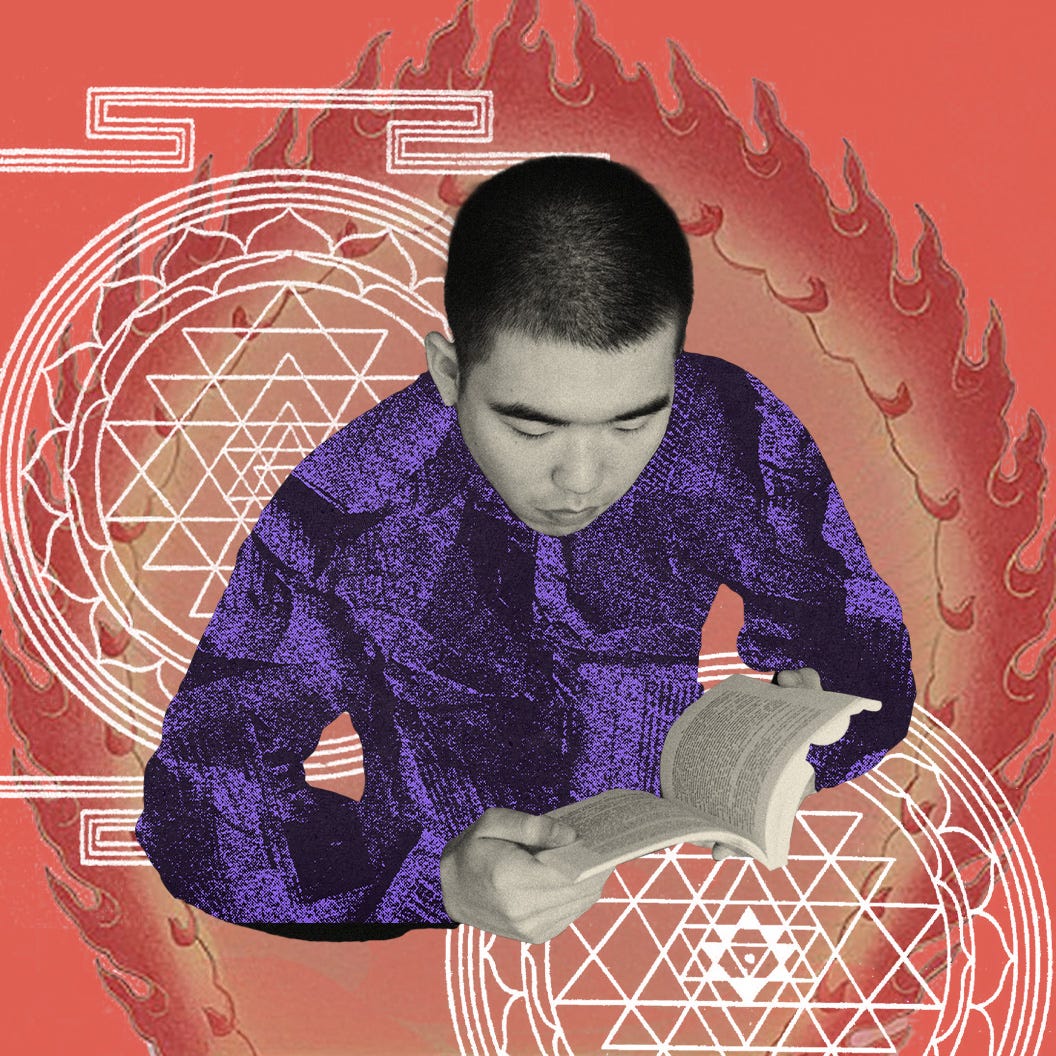
Floss, Student Coordinator & Integration Facilitator for Sādhana School, sat down on Zoom to talk to Lee — a yoga and yoga philosophy teacher, and year-long student of Embodied Philosophy’s in-depth programme into the non-dual Tantrik Shaiva-Shakta traditions, Sādhana School — to reflect on practice, philosophy, and the search for depth in yoga.
Floss: Why did you join Sādhana School?
Lee: I had done Jacob’s Matsyendrasaṃhitā practice last summer, and I really loved the way he taught it — this little nugget of knowledge, and then very deep practice. I resonated so much with that style of teaching, learning, practice and study. I hadn’t done a deep dive with another teacher in many years, and I just felt like it was the right time and the right person.
Floss: You described it at one point as almost “college-like,” but in a good way — like being invited into serious study again.
Lee: It’s definitely master’s level. And that’s really what I was looking for. It is so easy to find ways to scratch the surface, but I’d much rather go deeper.
Floss: What was your background before joining?
Lee: I’ve been practicing yoga on and off for probably 20 years. My entry point was actually philosophy — I took a philosophy of mind class in college, and the textbook was the Yoga Sūtras of Patañjali. From there, so much of it made sense to my internal philosophy, things that I had written before, or understood, or thought. It put some words and language to it. Later I found Buddhist meditation, then yoga studios, and eventually grew as a yoga student and eventually a teacher. I now teach āsana, meditation and yoga philosophy.
Floss: Can you talk about the relationship between theory and practice in Sādhana School?
Lee: I think theory gives language and understanding to direct experiences we might receive through practice. And on the other side, some of these deeper practices — like nyāsa or uccāra — don’t quite make sense without the theory.
With Sādhana School, we get this very deep level of learning and study, and then practices that bring it to life. The Mātrikā term was a really good example: we spent time talking about why sound and speech are so important, and then we did the practices, bringing those sounds to life internally.
At one point I joked, maybe our time would be better spent just practicing than talking about it. But the study matters because it gives us language. It helps us understand experience.
I think if we had just done the nyāsa without the study, it would have been really, really hard, right? Because it would have been like, why am I doing this? As teachers, too, we are always seeking to strike that balance between theory and practice.
Floss: How has your practice changed through the programme?
Lee: I think I always used to think study was going to be the way I moved deeper. But deeper practice, and being in the practice more frequently, has significantly changed who I am and how I understand myself.
Jacob’s push to sit for twenty minutes twice a day — and then Nataraj echoing that — has now become part of my day-to-day. I’m still doing twenty minutes a day, two times a day, which I think was a good push. It brings the practice to an even level with the study.
Floss: What has been the most valuable insight for you so far?
Lee: The Spanda term was really powerful. I feel like I had a direct experience of Spanda, and now I have the language to describe it. I really enjoyed the deep learning: where the teachings come from, the study of teachers like Abhinavagupta and Kṣemarāja, and the context for why we do certain practices.
And then the dance between Jacob and Nataraj as our teachers added a level of softness — a deep breath after times of deep study.
Floss: How have the teachings supported your life and teaching more broadly?
Lee: They’ve helped me give language to my own inner experience, but also to share that language with the people who practice with me.
Rasa is another example. I had heard of it before, but both Jacob and Nataraj have such a love for that idea. Now I can see that flavour, beauty and depth show up in my life and practice in a totally different way.
Floss: Any final reflections?
Lee:
I would just add, I’ve had this connection to Tantra for a couple of years now, but — until now — I haven’t had someone tied to the lineages like both Jacob and Nataraj are.
I think that has been the missing piece to my personal practice. I have found it so valuable.
Thank you for reading.
Interested in tasting the transformative teachings of Sādhana School?
You are warmly invited to join Embodied Philosophy’s 7-day retreat, The Heart of the Yoginīs: Kuṇḍalinī, Cakra Sādhana, and the Liberation of Passion - this July.
July 11th–17th
Join online or in person in Taos, New Mexico


Thanks for sharing our interview 🔱