This article is an excerpt taken from the Sādhaka Sourcebook, a resource written and compiled by Embodied Philosophy Founder and Teacher, Jacob Kyle, for Sādhana School - Embodied Philosophy’s most in-depth, university level programme into the non-dual Śākta–Śaiva traditions.
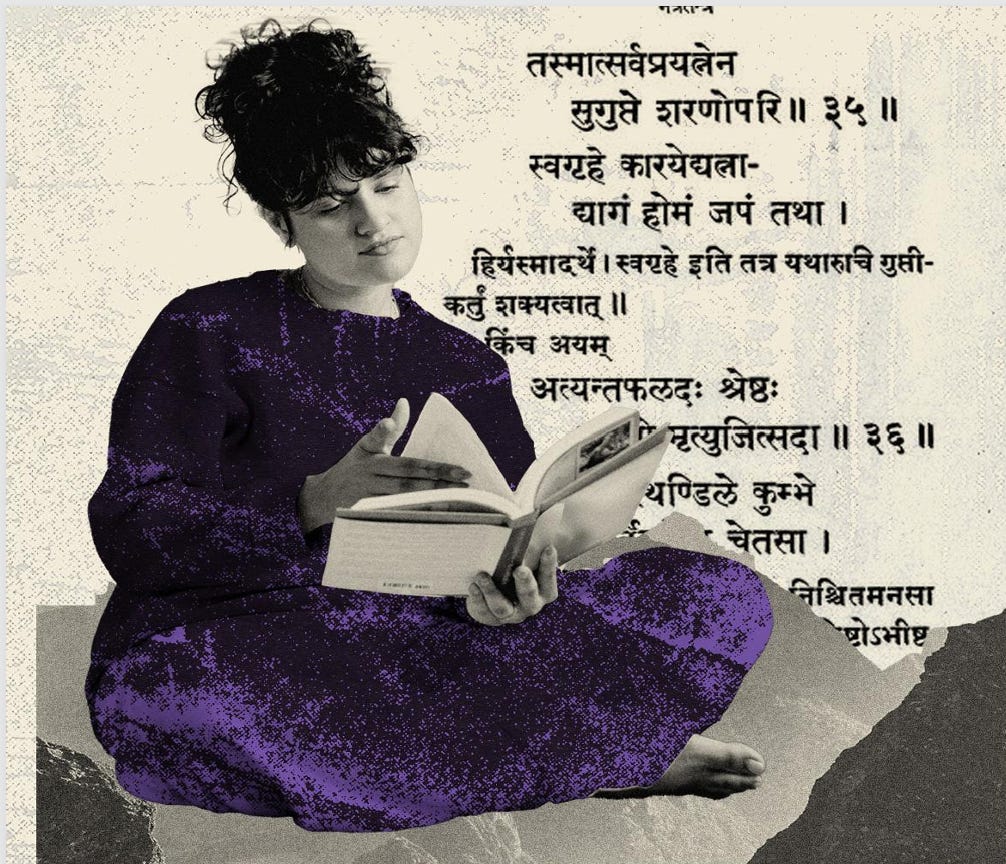
This is not a question with a single answer, but one that opens into layered possibilities — each of which reveals a different facet of the contemplative path. In the popular imagination, the purpose of spiritual practice is often cast in terms of stress relief, peace of mind, or healing from trauma. While sādhana may indeed bring these benefits, they are not its ultimate aim. These are byproducts of a deeper, more radical transformation that sādhana invites.
At its most fundamental level, sādhana is a process of remembering what we are — beneath habit, beneath personality, beneath even thought. It is a turning inward toward the subtle layers of experience, and ultimately, toward the ground of awareness itself. But this turning inward is not an escape from the world. On the contrary, it is a re-entry into the world with new eyes — more intimate, more porous, and more attuned to the living pulse of reality.
“At its most fundamental level, sādhana is a process of remembering what we are — beneath habit, beneath personality, beneath even thought. It is a turning inward toward the subtle layers of experience, and ultimately, toward the ground of awareness itself.”
In the non-dual Śākta-Śaiva traditions that inspire Sādhana School, the ultimate aim is not to transcend embodiment, but to recognize it as the very expression of the divine. Sādhana, then, is not a ladder to escape the human condition, but a means of sanctifying it — of perceiving the sacred not elsewhere, but here, now, in this body, this breath, this thought, this moment.
Sādhana awakens us to subtle perception. It refines our awareness so that we no longer view reality through the lens of habitual projection or inherited worldviews. We begin to see as awareness itself rather than as the limited self looking out. In this sense, sādhana is epistemological — it changes how we know. It is also ontological — it changes what we take ourselves and the world to be. But unlike academic philosophy, this transformation is not merely conceptual. It is embodied, lived, and felt. It unfolds as the dynamic presence of a clarifying creativity.
On another level, sādhana is a process of purification — not moralistic, but vibrational. We purify not to become “good” but to become clear. To see more clearly. To feel more fully. To act with discernment and power. The obstructions to this clarity are not ‘sins’, but fixations: rigid identities, unexamined beliefs, habitual reactivity, unconscious desire. Sādhana softens these structures not by attacking them, but by outshining them. In its light, we begin to experience spaciousness where there was contraction, fluidity where there was fixity.
“Sādhana is a process of purification — not moralistic, but vibrational.”
And yet, sādhana is not only about liberation from — it is also about awakening into. Into creative participation with life. Into new possibilities of expression. Into love that is not limited to emotion, but radiates as a way of being. Into freedom that does not remove us from responsibility, but infuses it with depth and compassion.
So the aim of sādhana cannot be reduced to a single goal. It is not just about self-realization or self-improvement or spiritual achievement. It is about learning how to live — how to live in a way that honors the subtlety of our being, that allows reality to speak through us, and that cultivates a disposition of reverence in the midst of impermanence.
In this way, sādhana is not a path to somewhere else. It is a deepening into this. It is a sacred reorientation toward the already present — the mystery that waits patiently beneath our distractions, our performances, and our fear.
And so the true aim of sādhana may not be to attain anything at all, but rather to uncover — to become intimate with what has always been here, quietly waiting to be seen.
Thank you for reading.
Ready to deepen your own Sādhana?
You may be interested in Sādhana School - Embodied Philosophy’s most in-depth programme yet, combining theory, textual study, and practice in the non-dual Śākta–Śaiva traditions.
The new term of Sādhana School - Mūdrā & Mātṛka: Linguistic Mysticism, Gestures of Awareness, & the Divine Feminine - begins on Wednesday, the 21st of January 2026.
Looking for a broader entry into meditation, contemplation and philosophy? Wisdom School may be for you: a year-long immersion into the world’s contemplative traditions, bringing together monthly lectures, guided meditations, book clubs, quarterly workshops and meditation practices to support a grounded, structured and expansive enquiry.
Explore the Print and/or Digital Issues of Tarka Journal in our online shop.