By Hap Savage
“For at least the last thousand years, perhaps longer, the concept of power in its political and social application has been intimately connected with Tantric theology – so intimately, one might suggest, that the one cannot be adequately understood apart from the other.” — Gupta & Gombrich 1986
Medieval India
Tantra, as understood popularly in the West, is broadly apolitical; it is held to be a deeply private practice, with private results experienced only by the tantric practitioner themselves.
In its Southeast Asian context, however, it was historically riven by dialectical tensions: On the one hand, drawing its spiritual efficacy from its transgressive and taboo practices; on the other, accommodating itself to local power structures by promising warlords access to magical powers gained thereby.
In this brief essay we will sketch two lines of inquiry. First we will examine the tensions in historical tantra, or, more properly, Śākta-Śaivism, and its relationships with structures of political power. We then will then take a stab at understanding the extremely divergent political understandings of “tantra” in the culture of the colonial world. For as it turns out, the political valence of the tantric tradition is remarkably variable. From origins in the political dropout culture of pre-medieval India, to mercenary black magic available for sale or rent to local strongmen, to a profound and esoteric theory and praxis available only to the educated class; then from a discovery by (and simultaneous invention of) scandalized Anglican colonial researchers, to appropriation by, in turn, American feminist rebels, Italian Fascist occultists, and English satanic jingoists, to eventual incorporation into the broadly “apolitical” new age spirituality movement which, in fact, inherits politics from all these.
In traveling this crooked path through the centuries, we will find further evidence that, as the second-wave feminist slogan puts it, “the personal is political.” Different constructions of the body politic, and various notions of the spiritual implications of private acts, both inform and are informed by political power structures and movements. Thus, the political ramifications of spiritual practice and philosophy are not implicit; they are in flux, open to interpretation, and require struggle.
First, some notes about the Indian historical context. Practices recognizable as “tantric” developed in the subcontinent during the relative stability of the Gupta and Vākāṭaka dynasties. Mass migrations, perhaps ultimately resulting from the construction of the Great Wall of China, brought an end to both these dynasties (as well as the western Roman empire) by the early sixth century CE. Thus ended the “Pax Gupta” and what is considered classical Indian civilization; there followed an extremely complex and unsettled period of political tumult in central and northern India, marked by warlordism, strife, and frequently changing allegiances. These years — stretching from the seventh to the eleventh century, when Ghaznavid invasions precipitated further change — also mark the flowering of the tantric tradition.
The politics of these centuries can be considered feudal: regional lords (in Sanskrit sāmanta (सामन्त)) extracted tribute and provided defense to local strongmen, who in turn extracted from and provided to villagers under their power. This hierarchical dominance structure came to be called a circle of influence or maṇḍala (मञ्डल), which, strikingly, was a political term before it became a religious or artistic one; the beautiful depictions of subdeities encircling a larger central deity, thought by Carl Jung to symbolize and catalyze harmony of mind, represent, in fact, an idealized model of feudal exploitation.1
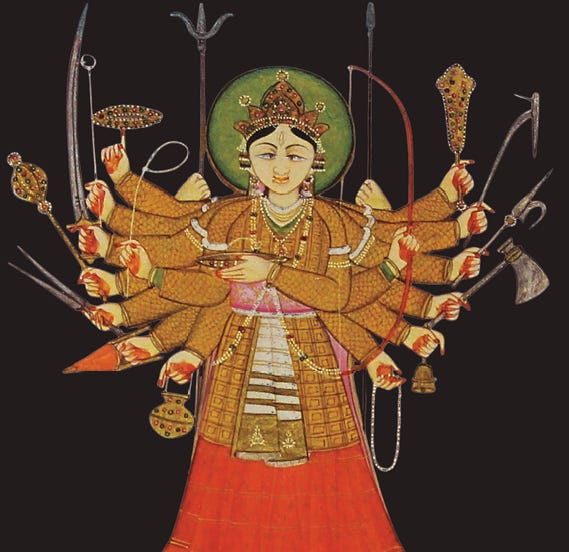
Also notable in the seventh and eighth centuries CE were increased depictions of fierce goddesses at local and regional palaces and courts, most especially Durgā (दुर्गा). Over these centuries, Durgā and her variants displace the Vedic deities formerly found in regal architecture. As her depictions become more common, her iconography changes, and she is increasingly shown with the insignia of royalty — the scepter, the crown, and the royal battle-drum. Indeed, Gupta and Gombrich report that kinglets in this period were symbolically married to Durgā upon ascending the simḥāsana (सिम्हासन), the “lion throne” — Dūrga, also, is normally depicted astride a lion.2
It appears that over these years of interregnum, Brahmanic ritual specialists, long close to state power and after many centuries of maintaining a relative sinecure, began to encounter competition from a newer breed of Śaivite ritualist, who laid claim to heterodox but effective methods of advancing their patrons in this changed and highly competitive landscape. Foremost among these was the ability to propitiate and command fierce deities; goddesses of disease and catastrophe such as Durgā, Kālī (काली), and the “Seven Mothers” or Saptamātṛkā (सप्तमातृका), all of whom are unknown before the late Gupta period and rise meteorically to prominence thereafter. The Seven Mothers in particular originate as demonesses responsible for illness and death of children, who undergo a transformation, not uncommon in folk religion, from fearful spirits to goddesses worthy of worship.
The mechanism of this transformation in medieval India is the tantric adept, who begins as an ascetic dropout, signaling his devotion to the spiritual path by performing transgressive acts guaranteed to render him ritually impure and unpalatable to mainstream society. The sine qua non of this, in full-blown Kaula ritual, is the consumption of the sexual fluids of the guru and consort; but there are many ways of dirtying oneself. To be impure, to haunt the cremation ground, also put these ascetics at risk of both psychic and physical disease, and thus brought them into proximity with its various demons. Their familiarity with, and sangfroid around, disease, disaster, and death, at some point pivoted from social liability to marketable job skill, as warlords wished not only to protect themselves and their families from such deities, but more importantly, to direct them against their many enemies.
Interestingly, in iconography over time, an eighth is added to the Seven Mothers, simply to fill out the mandala form; the male deity at the center, alone or with a consort, is analogized with the tantric adept, ruling over goddesses of disease just like a duke over eight earls. To this day in the valley of Kathmandu there are several cities, formerly capitals of small Newar kingdoms, which are each surrounded by eight mātṛkā temples; the entire urban mandala is now known as navadurgā (नवदुरगा), “nine Durgās”.3
Further, in feudal India “kingship” was being made over in the image of a heroic male figure whose sexual powers were homologised with his military power and his very ability to fill the royal role.4 Tantric ritualists, being intimately conversant with both sex and death, were able to help here too; contemporary satires poke fun at royals being duped into all manner of extreme practices by Śaiva ascetics who promise to restore their sexual prowess. Such a court tantrika could also be a freelancer; Alexis Sanderson quotes several examples of tantric ritual specialists hired “by the job” to repel invasions.5
Surveying these developments, a picture begins to emerge: Brahmanic religion, with its complex fire sacrifices and well-established caste affiliations, lost its hegemony with the fracturing of the centralized state, producing a power gap into which flowed a formerly outcaste congregation whose outlook and abilities were more in line with the times; extreme circumstances demand extreme measures. As these previously impolite and unfashionable practices became more widely known if not de rigueur, their philosophical implications began to be reimagined by their highly educated new adherents. Samuels6 argues eloquently and convincingly for a trajectory in which Kaula ritual remains more or less the same, while the emphasis shifts from semen and its consumption to the moment of orgasm as an opportunity for insight into nonduality; from the objective, we might say, to the subjective.
20th Century Europe
This is all very interesting — but not that hard to follow. In a time of political stability, peace, and prosperity, a group of dropouts, in antinomian fashion, inverted the religious stance of the dominant culture and its emphasis on purity and propounded a spiritual path of maximum impurity. Later, during a time of instability, war, and uncertainty, these same outsiders found patronage, perhaps in the interests of survival (it is easier to live on the margins of society in times of surplus). Their patrons, in turn, reimagined their practices, in the process rendering them both more palatable and, through the generative dialectical tension of the whole situation, creating a hybrid of incredible philosophical richness.
Change the context, though, and everything changes.
By the twelfth century CE, Persianate Muslim rule in India was more or less total and – perhaps coincidentally, perhaps not – the tantric traditions we have been following began to disappear from view, going underground and being assimilated into the nascent milieu of hatha yoga. Underground it stays, until the arrival of the East India Company and, with English direct rule, a wave of mostly Anglican scholars representing the developing discipline of “comparative religion.” In poring over manuscripts and interviewing local informants, they began turning up seemingly religious texts and practices which, to the Victorian colonizers, seemed highly irreligious if not debauched. Many of these were found in texts called tantra, and our scandalized (and understandably fascinated) scholars began using this word as an umbrella term to categorize these appalling chimerae, so religious in form, so blasphemous in content.
Here our story begins to get even weirder, and the characters we encounter become by degrees less savory. Primary among translators of texts we now consider “tantric,” of course, was the enigmatic Sir John Woodroffe, who wrote under the odd pen name Arthur Avalon. Woodroffe, a barrister, became interested in tantra (so the story goes) after undergoing a psychic attack by a tantrika hired by the defense in a court case he was prosecuting – our earlier investigations should help us make sense of this phenomenon of “black magic for hire.” He proceeded to learn Sanskrit, study meditation under a guru from whom he received several initiations, and translate (with the help of a native accomplice) numerous Sanskrit texts which have been incredibly influential on the popular conception of Indian esotericism, likely the source of most popular explications of kundalini (कुनदालिनि) and the cakra-s(चक्र), for instance.7