This article is an excerpt taken from the Sādhaka Sourcebook, a resource written and compiled by Embodied Philosophy Founder and Teacher, Jacob Kyle, for Sādhaka School - Embodied Philosophy’s most in-depth, university-level programme into the non-dual Śākta–Śaiva traditions.
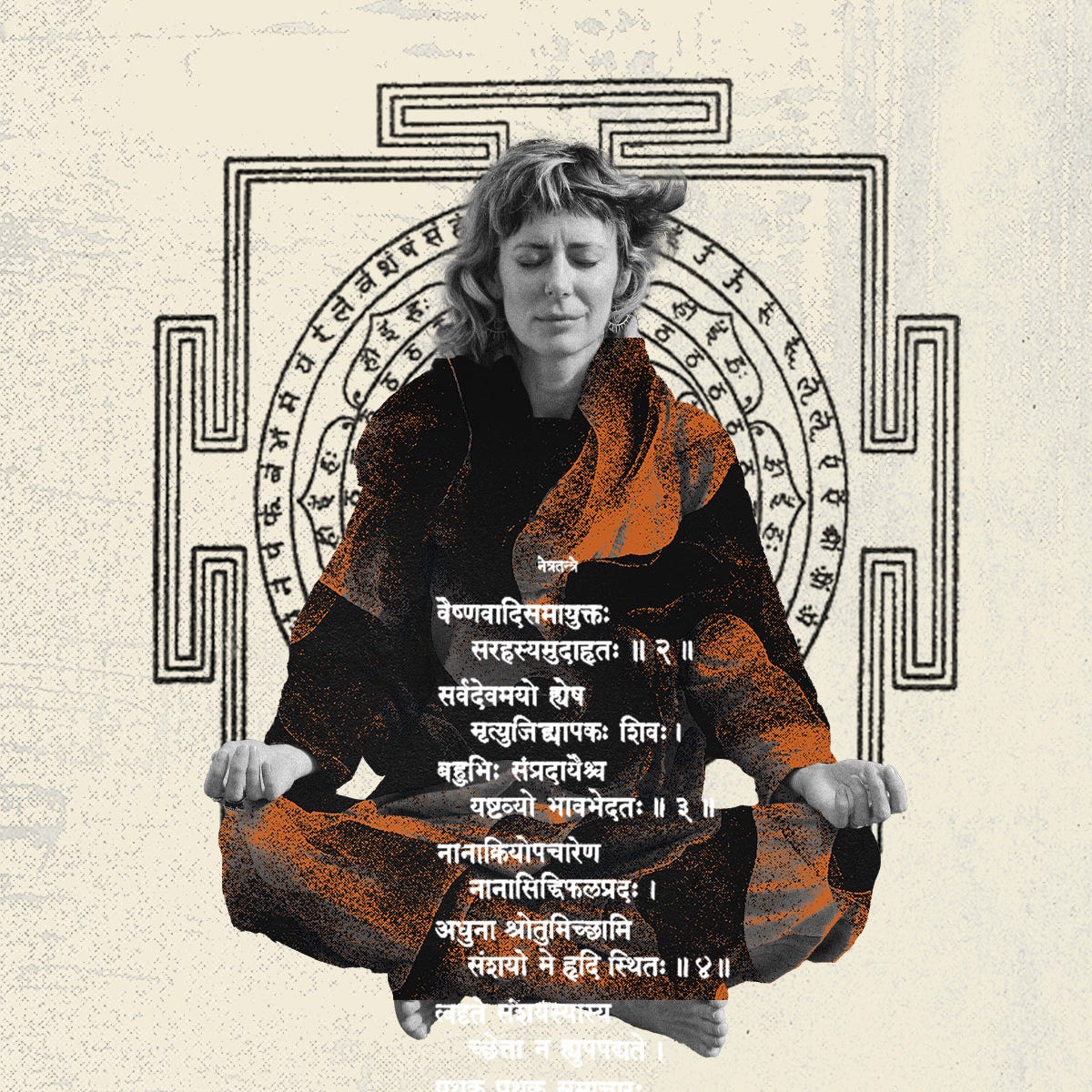
Sādhana is more than a spiritual path.
That is, it is a way of learning, a mode of inquiry, a discipline of integration. While the term “pedagogy” often evokes the image of classroom instruction and intellectual curriculum, in the context of contemplative traditions, pedagogy is something far more embodied and existential. It is not limited to the mind’s acquisition of ideas. It concerns the whole being — body, breath, intellect, imagination, desire, and will.
At its heart, sādhana is a curriculum of transformation. It teaches us not through abstract instruction alone, but through direct engagement. Its lessons do not arrive in the form of neatly packaged conclusions. They emerge slowly, through repetition, through friction, through revelation — by way of practice, persistence, and perceptual refinement. Like any serious course of study, sādhana requires commitment and patience. But unlike most modern educational systems, it does not divide knowledge from experience. It aims at wisdom, not just information.
“Pedagogy… is not limited to the mind’s acquisition of ideas. It concerns the whole being — body, breath, intellect, imagination, desire, and will.”
In this sense, sādhana rewrites the dominant model of modern learning. Rather than prioritizing speed, productivity, or quantifiable achievement, sādhana pedagogy favors depth, slowness, and internalization. It does not ask, “How much have you mastered?” but instead, “How deeply has this lived in you?” It does not ask whether you can repeat teachings, but whether you have become them.
This pedagogical orientation is especially important in the context of Sādhana School, where the emphasis is not merely on content, but on transmission. While we study primary texts and philosophical frameworks with rigor, these are not ends in themselves. They are catalysts. The texts become living interlocutors. The philosophical insights become interior provocations. The practices become mirrors, and eventually, thresholds. This is not passive consumption. It is relational education.
In the traditional Indian context, learning was always intimately tied to sādhana. Study (svādhyāya) was inseparable from repetition, recitation, and ritual practice. To learn something, in the non-dual Tantrik traditions, means to inscribe it into the body, to harmonize oneself with its vibration. The teacher is not simply a conveyor of information, but a transmitter of śakti, presence, and a reorienting view. The student does not memorize doctrine but undergoes adhikāra — a ripening of receptivity, a development of capacity. Learning is measured not by output, but by becoming.
This is the spirit that Sādhana School seeks to recover and rearticulate. Sādhana as pedagogy is a reclamation of depth in a time of distraction. It is a call back to the ancient intuition that wisdom is not the result of accumulation, but of transformation through relation — with practices, with texts, with teachers, and most importantly, with the subtle intelligence of one’s own interiority.
And yet, this is not an escape from modernity. Rather, it is a reweaving of the ancient into the fabric of the now. We live in a world of complexity and contradiction. Sādhana pedagogy does not ask us to abandon it, but to meet it more deeply — armed not with answers, but with attuned perception and a refined sense of discernment.
“To engage sādhana as pedagogy, then, is to reimagine what it means to study, to learn, and to become.”
To engage sādhana as pedagogy, then, is to reimagine what it means to study, to learn, and to become. It is to submit to a process that does not flatter the ego, but liberates it from its compulsions. It is to allow the rhythms of practice to educate the nervous system. It is to trust that the body, too, is a form of memory. It is to recognize that the deepest lessons do not announce themselves with fanfare — but arrive quietly, when we have become simple enough to receive them.
In this light, the sādhaka is not merely a practitioner, but a student in the truest sense: one who does not presume to know, but who is willing to be changed by what they encounter.
Thank you for reading.
Ready to deepen your own Sādhana?
At Embodied Philosophy, we offer two year-long programmes, each designed to meet you at a different level of depth and commitment.
Wisdom School is a year-long immersion into the world’s contemplative traditions, bringing together monthly lectures, guided meditations, book clubs, quarterly workshops and meditation practices to support a grounded, structured and expansive enquiry.