


From Tarka Vol. 9: On Power, by Vinod Bhatia
Antecedents of Devī
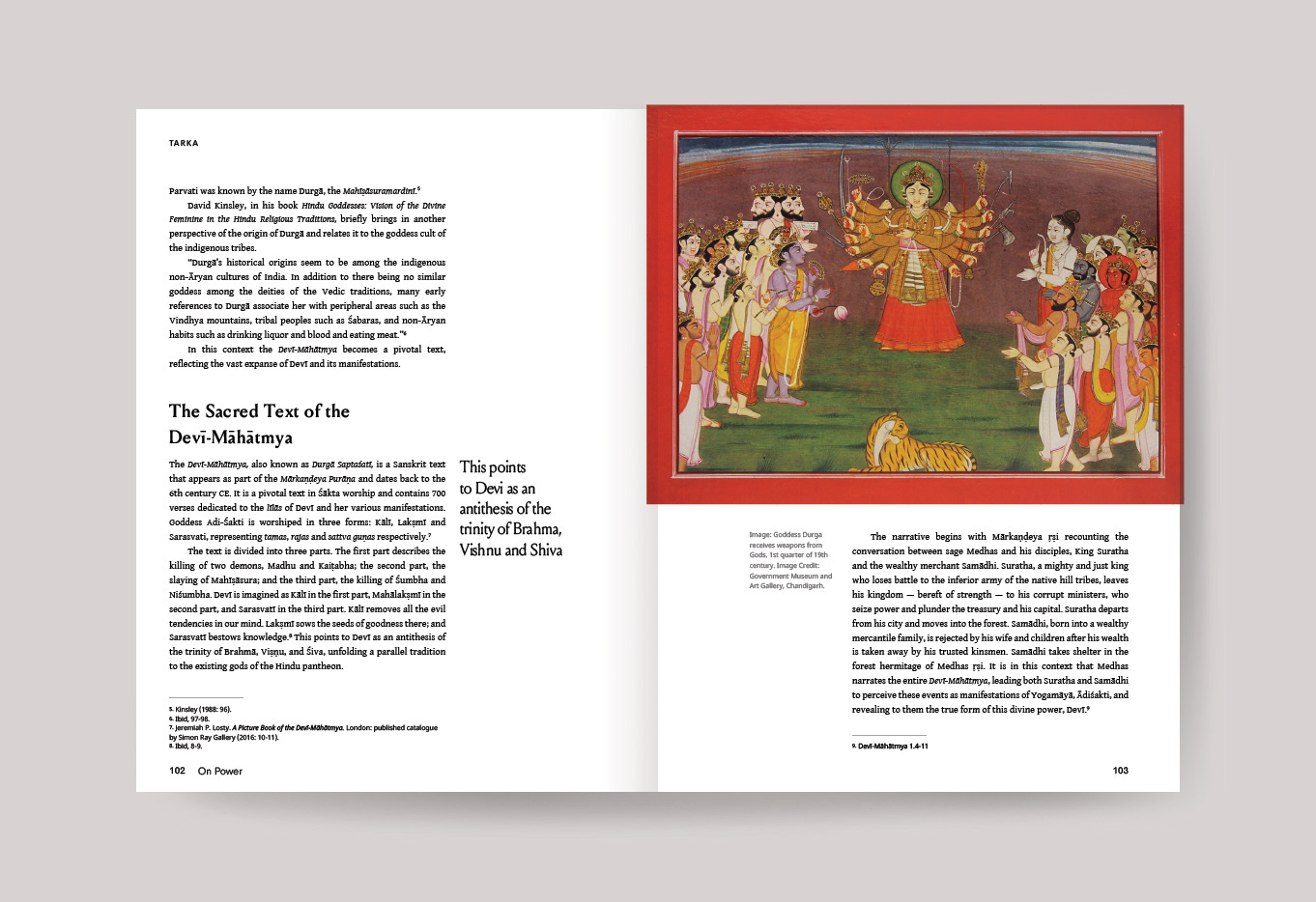
Devī is the supreme being in the Śākta traditions and the basis of tantra in Hinduism, Jainism and Buddhism. She is an embodiment of power that represents cosmic energy and is manifested in numerous forms. In Vivekananda’s words, “The Absolute is formless, but energy is female. When the energy takes form, it is called Mother. Mother is the moving power, disturbing into waves the water-calm of the Absolute.” The intertwining of Devī with the Absolute is presented as the union of Śiva and Śakti in Tantra, as puruṣa and prakṛti in Vedic traditions and as brahman and māyā in the Advaitic system. Devī, as the universal energy, is kuṇḍalinī, omnipotent, and once awakened she opens up the path of self-realization. This essay examines the visual representation of the Devī as goddess Durgā, the fierce one in the context of the sixth-century Sanskrit text of the Devī-Māhātmyam. A substantial text that consolidates the Devī cult in different regions of the subcontinent, the folio analyzed in the essay is from the Devī-Māhātmyam set, comprising 173 miniatures from the Kangra school, each 18 centimeters in height, and 26 centimeters in width. The work belongs to the Chandigarh Museum and is dated to the second half of the 18th century. It establishes Devī as an emblem of power and valour and gives insights into the imaginative vision of the Indian painter, to visualize the divine within the Indian miniature traditions of the hill regions of north India.
Within the plethora of Hindu Gods, Devī represents the feminine energy and becomes the central deity amalgamating various female goddesses already existing within diverse traditions. She encompasses the village goddesses worshiped in the Indian subcontinent as local female deities in folk traditions, or as Sarasvati, Usha, Aditi, Prithvi in the Vedic traditions. Devī has innumerable forms and names and yet retains her supreme place in the Hindu pantheon. She is referred to as Shakti (Śakti) or Durgā, one who fights with demons. While Shakti and Durgā are interchangeably used, Shakti refers to the power to annihilate the demons. Shakti manifests the inner force in the absence of which no action can be performed. It symbolizes the energy evoked by the Gods to restore the cosmic balance. On the contrary, one popular etymology of Durgā derives from durg, denoting ‘fortress’: a strong and powerful fortress that protects its inhabitants. According to David Kinsley, “Durga is inextricably associated with the physical world, the world she creates, sustains, and protects in her various forms.” This essay tries to relocate the presence of the Devī cult at the center of the Hindu pantheon, and suggests a contrasting point of view offered by Devī through her association with the feminine, thereby creating a space of her own within the dominance of the patriarchal cults of Viṣṇu and Śiva through her divine and fierce manifestations.
The visual presence of Devī as Durgā evokes an encounter with Vīra rasa in the minds of the adherent. Devī becomes a potent deity, meditating upon her arouses one’s latent power, leading to experiencing victory. Rasa literally means the ‘sap’ or the extract of plants. At a micro level it signifies the non material essence of a thing, and is causally related to bhāva – the ‘mood’ or emotional state of the viewer, audience, or the one who experiences. Bharata proposes eight such moods, each having a corresponding rasa. These are śṛṅgāra (the erotic), hāsya (the amusing), karuṇa (the compassionate), raudra (the furious), vīra (the heroic), bhāyanaka (the fearsome), bībhatsā (the odious) and adbhuta (the marvelous). Another rasa that was added to the list later is the śānta (the quiescent) completing the total to nine, known as the nava-rasas. Amongst all the nava-rasas that appropriates the visual depiction of Durgā in Devī-Māhātmyam is the vīra rasa. The Nāṭyaśāstra states that the vīra rasa relates to the superior type of persons and has excitement as its basis. Utsāha is the sthāyibhāva of vīra rasa referring to the heroic sentiment. The episode of Durgā slaying the buffalo demon Mahiṣāsura from the Devī-Māhātmyam, becomes one such performative moment evoking vīra rasa representations that can be seen across different visual styles of popular, calendar, folk and miniature art traditions.
It also brings focus to the presence of local chieftains of the Punjab hills and their conflicts for power amongst rivals. Devī miniatures from the region reveal the complexity of such relationships of patronage and its association with warrior cults of the northern hills. To conquer wars, one requires power and Devī - as embodiment of power - finds a prominent representation in these geographies demonstrating such territorial conflicts. From Rajasthan to Punjab hills, this control of power leads to the recurrence of Durgā in Indian painting traditions.
According to Vidya Dehejia, “as Jaganmata, or Mother of the universe, she assumes cosmic proportions, destroying evil and addressing herself to the creation and dissolution of the worlds.”
There are several mythological accounts of the origin of Durgā in the Purāṇic period. The Skanda Purāṇa relates that once upon a time a demon named Mahiṣa threatened the world. Śiva requested Parvati to slay the demon. Parvati then assumed the form of a warrior goddess and defeated the demon, who took the form of a buffalo. Thereafter, Parvati was known by the name Durgā, the Mahīṣāsuramardinī.
David Kinsley, in his book Hindu Goddesses: Vision of the Divine Feminine in the Hindu Religious Traditions, briefly brings in another perspective of the origin of Durgā and relates it to the goddess cult of the indigenous tribes.
“Durgā’s historical origins seem to be among the indigenous non-Āryan cultures of India. In addition to there being no similar goddess among the deities of the Vedic traditions, many early references to Durgā associate her with peripheral areas such as the Vindhya mountains, tribal peoples such as Śabaras, and non-Āryan habits such as drinking liquor and blood and eating meat.”
In this context the Devī-Māhātmya becomes a pivotal text, reflecting the vast expanse of Devī and its manifestations.
Thank you for reading this excerpt from a longer essay.
To read the full essay get the new issue of Tarka On Power, in print or digital, from the Tarka Journal online bookstore.

About the author: Vinod Bhatia, PhD, is currently an Assistant Professor with the Department of Design Space, NIFT Haryana. With a Masters Degree in Design and Post Graduate Diploma in Indian Aesthetics from Jnanpravaha, Mumbai. His research inter ests revolve around material and visual cultures, with special emphasis on Indic traditions of image making.