


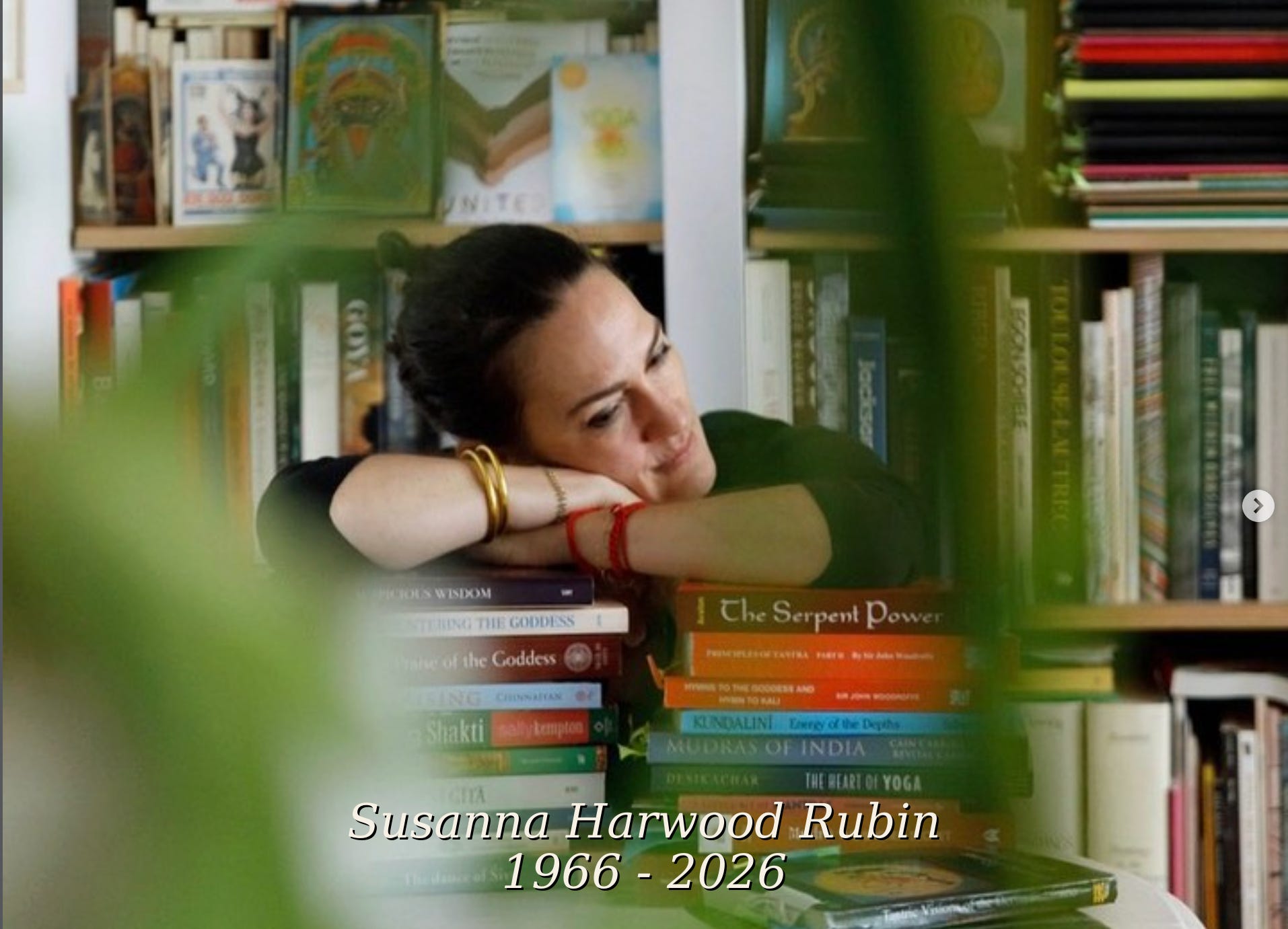
Just a few weeks ago, Embodied Philosophy lost a close friend and teacher. After a decade-long struggle with breast cancer, Susanna Harwood Rubin left this incarnation on Saturday, March 28th 2026.
Susanna was an artist, writer, yoga teacher, the published author of Yoga 365, and an uncompromisingly devoted practitioner. She was a thoroughly bhakta-yoginī — a devotee whose orientation toward practice is one of offering.
Her kind of offering did not require special conditions or a superficially 'yogic' state of mind. It was the kind that included everything — her passions, hopes, confusions, fear, and pain — returning it all to the divine. She made all of her experience – the good, the bad, and the ugly – a form of worship.
For those who followed her on Instagram @susannaharwoodrubin, this devotion was palpable. In post after post, after sharing her refreshingly vulnerable authenticity, she frequently concluded with Oṃ Namaḥ Śivāya and Jai Mā – signaling her unimpeachable vision of reality as divinely embodied in the non-dual expressions of Śiva and Kālī.
Susanna was always transparent about the spiritual truths that gave meaning to her life, and was therefore rare among today’s yoga teachers – many of whom maintain an anxious agnosticism about such things for fear of alienating a secular audience. Susanna had no such anxiety. She embodied a commitment to the path that excluded nothing from her divine life – not even the cancer that she lived with until the end.
Because her many Instagram writings are still online and available, the wisdom she shared remains alive to explore – both for those who are only just learning about her life, and for those of us wishing to honor her memory. In the beautifully rich reflections that she started composing in 2018, she shared honest, vulnerable, and courageously transparent truths about her cancer journey.
During a time when many modern ‘influencers’ were increasingly using their Instagram platform to construct an inauthentic persona for shallow likes and follows, Susanna made a very different choice. She used her platform to process, in real time and in public, a struggle that she faced – always with a kind of clarity and wisdom evident in those who have integrated their spirituality into all aspects of life.
The inspiration and wonder that emanated from Susanna established her in many of our eyes as a unique authority – one of the modern yoga world's rare "wise elders." She showed us a way to talk about deep fears, about our inevitable confrontation with mortality – all the while demonstrating that it is possible to talk about life's hardships through the lens of a spirituality that provides guidance, hope, and acceptance.
Susanna was a modern-day Tantrika and student of Śrī-Vidyā scholar-practitioner Douglas Brooks. She made regular pilgrimages to the Chidambaram temple of Nātarāja in Tamil Nadu, calling it "the home of my heart." She understood the significance of sacred geography and extended that sensibility to the geography of her own embodiment. In my CHITHEADS interview with her in 2019, I was struck by her inclination to reject the languaging around her cancer as one of a "battle" or a "fight." She rather considered it a deep inner conversation with her own body. She chose to see even in this experience a face of the divine and a source of her own Self-recognition. She turned her struggle into a mode of practice – and by inviting others to witness it, she gave us the sacred gift of her example.
I encountered Susanna's impact on the yoga world before I ever met her. When I was teaching at YogaWorks SoHo in New York, there was a small hardcover book available in the gift shop: Yoga 365: Daily Wisdom for Life On and Off the Mat. I picked it up without knowing anything about the book or its author, as a Christmas gift for my mother.
The book is built on a simple principle — one reflection per day, drawn from the concepts and teachings of the yoga tradition. Not a new pose a day. Not a fitness tip. A genuine invitation to understand yoga as a complete way of engaging with experience. The title alone makes the argument: yoga is not something you do three times a week, or whenever you need a good stretch. It is a daily orientation. It is a way of life.
I discovered that Susanna was the author of Yoga 365 after Nataraj Chaitanya recommended her as an ambassador for Embodied Philosophy's first Meditation Resolution in 2018. Meeting Susanna was a small revelation – the kind one experiences when meeting a kindred spirit on the path of spirituality. In a city like NYC, with its endless supply of dedicated yogis, Susanna was one of a small but passionate group of teachers and practitioners bound not exclusively by postural yoga trends but by a shared devotion to the deeper spiritual teachings of yogic traditions.
This is rarer than it might sound. There are many people in the yoga world who know about yoga's liberative aims – although often little more than what they've learned about the Yoga-Sūtras. While Susanna was not a scholar, she studied with scholars who in recent decades have greatly expanded our understandings of yoga's texts and history. She absorbed that knowledge and distilled it through the lens of her own experience. For Susanna, the tradition was not simply a philosophy, worldview, or set of esoteric practices, but a dynamic, living source of insight and transformation.
This orientation showed up in how she taught. It showed up in what she understood to be most urgent and meaningful. It showed up in the personal conversations we shared over the occasional meal or virtual catchup, as she naturally and spontaneously elevated the exchange toward the spiritual wisdom that moves all of us. She "walked the talk," as they say, dancing through life in alignment with her dharma.
Susanna participated in Embodied Philosophy's Meditation Resolution every year for seven years. Across all of the resolution's permutations, she remained a constant power-house: passionate, accessible, capable of distilling esoteric depths without flattening them. There was no contradiction in her between the breadth of her knowledge and the devotion she embodied. Both came from the same place of authentic experience.
The last time I saw Susanna teach, I was struck once again by the quality that had struck me at our first lunch years earlier: the sense that she was not performing the teachings (as so many do), but reporting from inside the coordinates of her own sādhana. There are few things I find more beautiful or admirable in life, particularly in a modern spiritual environment where so many bypass deep spirituality for superficial wellness or self-improvement.
There are passages from within the Pratyabhijñā literature that speak of prasiddhi, the kind of knowing that is so intimate and foundational that it precedes any formal act of cognition. It is the knowing that you already are, before you know that you know it. I am not sure Susanna would have used that vocabulary, but she nevertheless lived inside that orientation. The tradition was prasiddha for her — not superficially adopted but recognized and accomplished, not merely learned but resonantly remembered at the deepest layers of her being.
Susanna, you were so loved, and I wish I had had the good sense to spend more time with you. I'm sorry that – due to my infamously shoddy organizational skills – I had to cancel what would have been your second CHITHEADS interview just a day before your final treatment. While that will surely persist in my personal catalogue of life's regrets, I know that in the next lifetime, we will find each other again on the path of sādhana.
Thank you for all of the blessings you gave us in this life. Thank you for your teachings. Thank you for your radiant warmth, your vitality, and your artful honesty. Thank you for inspiring the teachers and students who learned from you at Embodied Philosophy and everywhere else blessed by your presence.
And, perhaps most importantly, thank you for showing us what it looks like to live a life in pursuit of wisdom, in alignment with liberation, and in sacred dialogue with the divine in its manifold expressions. We will miss you, but never forget you.
In your memory,
Jacob Kyle
Director of Embodied Philosophy
Thank you for reading.
Sign up for Embodied Philosophy’s The Scaffolding Newsletter, and receive a free Yoga Philosophy Reading List in return.
