Anyone who has spent real time on a yoga mat has, at one point or another, been told about Patañjali’s eight limbs. Yama, niyama, āsana, prāṇāyāma, pratyāhāra, dhāraṇā, dhyāna, samādhi. We have heard them mentioned at the beginning of class, in workshops, or in teacher training programs. We have taught them to students – sometimes based on a selective interpretation that extends from our own cultural commitments. Of the vast yoga philosophical material, the eight limbs are what many return to, again and again, as a kind of sacred ladder.
What is less often said is that Patañjali’s eight limbs are only one yoga among many. The Bhagavad Gītā alone offers several — karma-yoga, jñāna-yoga, bhakti-yoga, dhyāna-yoga — and refuses to rank them. The Mahābhārata’s Mokṣadharma preserves yogas older and stranger than anything in the Yoga Sūtras. The Upaniṣads speak of a yoga of syllable and breath that predates Patañjali by centuries. The Pāśupatas had their own yoga, as did the Pāñcarātrins, the Jainas, the early Buddhists, the Nāth siddhas, the haṭha traditions that rebuilt the whole edifice around the subtle body.
Each of these is a classical yoga system. Each presumes its own metaphysics, its own anthropology of the practitioner, its own account of what liberation means and how a human life might be oriented toward it. And in eleventh-century Kashmir, in a commentary on a tantra most yoga practitioners have never heard of, Kṣemarāja did something quietly extraordinary: he took the eight limbs one by one and rewrote each of them as a mode of non-dual recognition — producing, in effect, yet another classical yoga, one that absorbs the Pātañjala scheme by reading it from the inside.
In the Netra Tantra’s eighth chapter — the paradhyāna, the “supreme meditation” — yama is no longer the ethical threshold one crosses before practice begins. It is saṃsārād virati — the constant turning of awareness away from transmigratory identification. Niyama is not observance; it is bhāvanā pare tattve, continuous contemplation of the supreme reality. Āsana is not a posture. It is the seat one attains by resting in the central prāṇa and grasping one’s own power of knowing as ground. Prāṇāyāma is not breath retention but the transcendence first of gross, then of subtle breath, culminating in the supreme spanda “from which one never again falls.” Pratyāhāra, dhāraṇā, dhyāna, samādhi — each is rethought in the same key. What we had taken as a technology of suppression becomes a phenomenology of recognition.
“Pratyāhāra, dhāraṇā, dhyāna, samādhi — each is rethought in the same key. What we had taken as a technology of suppression becomes a phenomenology of recognition.”
This is, in fact, what the Śaiva commentarial tradition does again and again. Somānanda’s Śivadṛṣṭi reads the whole apparatus of perception and agency as modalities of Śiva’s self-recognition. Utpaladeva’s Īśvarapratyabhijñā-kārikā takes ordinary cognition — memory, recognition, the unity of the knowing subject across time — and shows, step by step, that each of these is unintelligible except as the self-disclosure of a single non-dual consciousness. Abhinavagupta’s Tantrāloka absorbs the entire ritual and yogic inheritance of the Mantramārga — initiation, mantra, mudrā, the hierarchy of the tattvas, the whole architecture of practice — and reorganizes it around the threefold distinction of āṇava, śākta, and śāmbhava upāyas: the same gestures, received at progressively subtler registers of recognition. Kṣemarāja, writing in that lineage, performs the move on a text one might not have expected to yield to it. The Netra Tantra is a ritual scripture. Its eighth chapter, on its surface, offers what looks like a conventional eightfold yoga. What the Netroddyota does is show that this yoga, read carefully, was never a technology of suppression at all. It was always the phenomenology of recognition, articulated in limbs.
In each case, the gesture is the same: the ladder is not kicked away. It is resituated and reinterpreted to align with the perspectives of non-dual Śākta-Śaivism.
Kṣemarāja offers a philosophically precise version of this move, similar to what Abhinavagupta does in āhnika four of his Tantrāloka. Every limb, held up to the light of pratyabhijñā, turns out to have been a figure of consciousness recognizing itself all along. The practitioner does not arrive at samādhi by accumulation. She arrives at it by recognizing that what she has been doing, at every rung, was already saturated with what she was reaching for.
“The practitioner does not arrive at samādhi by accumulation. She arrives at it by recognizing that what she has been doing, at every rung, was already saturated with what she was reaching for.”
For the yoga teacher, for the long-time practitioner, for anyone who has felt the subtle insufficiency of the eight limbs taught as a sequence of acquired states, this is, I think, what has been missing.
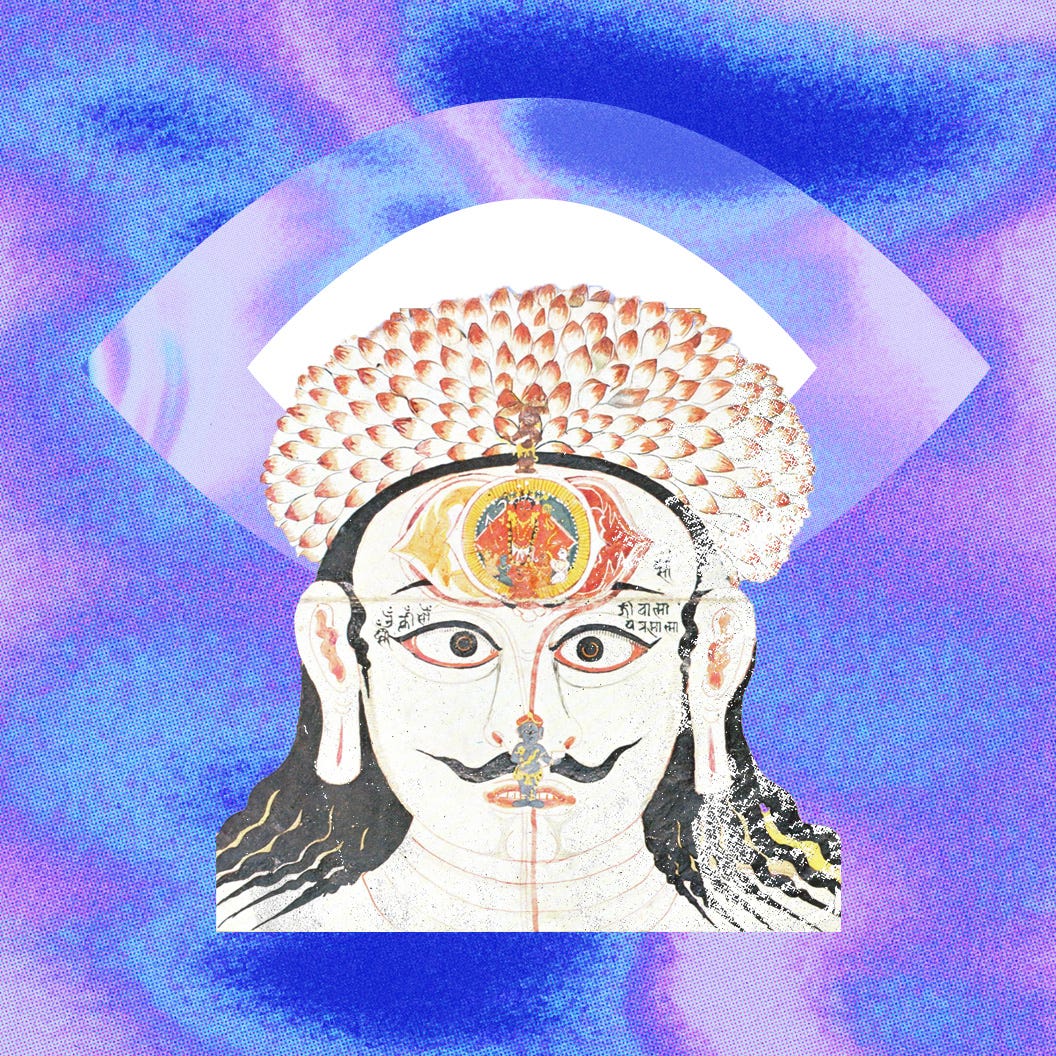
This spring, Sādhana School takes up this reading as a part of a broader exploration of the “third eye” — through the Netra Tantra, the Vijñāna-bhairava, and selections from Abhinavagupta’s Tantrāloka, across eight weeks of study, practice, and contemplative inquiry.
If you are interested in going deeper into the non-dual Tantric traditions, this could be for you.
Select chapters of the Netra Tantra will be the source of fascinating insight. We will read it slowly, in dialogue with the subtle-body yoga of chapter seven and the comparative contemplative frame that runs throughout. Week seven is devoted to a cross-traditional survey — Christian mysticism, Sufism’s baṣīra, Plotinus, Dzogchen, and the Eye of Horus — led by a guest teacher who situates the Tantrik teaching within its broadest comparative frame. The course closes with a satsang, and an orientation and ritual that integrates what we’ve learned into the life ahead.
The Third Eye: Perception and the Subtle Yoga of the Netra Tantra
Starts Wednesday April 29 2026 | Wednesdays, 9:00–11:30 am ET | 8-week term
With Jacob Kyle & Nataraj Chaitanya