


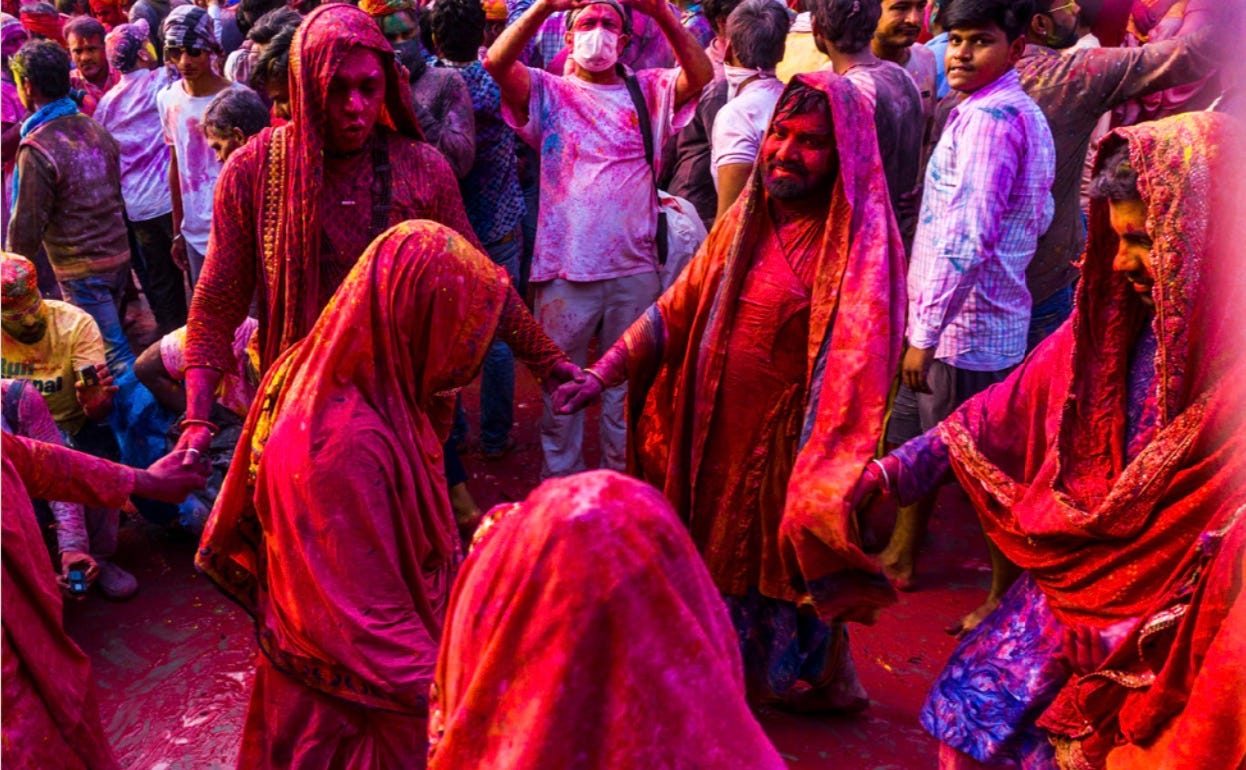
I’d already finished a full cupful of chilled tandai—and was heading for a second—when my brother-in-law approached me with words of caution. “Don’t drink the green stuff,” he advised. “It’s laced.”
Too late.
Unknowing of what most things are in India, I’d grabbed the green cup. I was thirsty because I’d been dancing all morning with a pack of women I didn’t know in a local park. It was the annual Holi festival and things had already gotten wild. They were about to get even wilder as the “green” started to take its effect.
Famed the “festival of colors,” Holi occurs on the brilliant full Moon in the Vedic “month of flowers.” It’s signaled by bonfires burning up collective animosity in the streets. In our English idiom, we “bury the hatchet.” On Holi, these North Indians burn it up in every neighborhood.
Enemies become friends. Servants and their employers embrace. Children dump buckets of colored water on their elders’ heads. No one minds. It’s great fun to be pummeled with water balloons by three friends on a motorcycle wearing rainbow wigs—or to stalk the neighborhood armed with a water gun hunting for similar prey of your own.
The cause for celebration is the stuff of myth and legend.
Once an indestructible demon—Hiryanakashipu—oppressed the earth. He couldn’t be killed by either god, human, or animal. He couldn’t be killed either in the house, or outside it, either in the day or night. In this way, he eluded all attempts to subdue his evil reign.
Hiranyakashipu’s son, Prahlad was born to defeat him, setting his devotion on Narasiṁha (the half-man, half-lion avatāra of Vishnu) to accomplish his fate. To defeat a demon who lies in the cracks requires a similar foe. Narasiṁha embodies the power of the liminal (the “betwix and between”) as a “third option” to the opposition of right and wrong.
As Prahlad planned to defeat his father, his aunt, Holika, lured him to sit in a burning fire with her. She tricked him into believing that she would offer protection. Instead, she wore a magic cloak that prevented fire from burning her, but left Prahlad vulnerable to the flames.
Prahlad trusted. He didn’t react. Instead, he prayed. As a devotee of Narasiṁha he knew a solution would arise that would produce a surprise outcome.
Just as he was to be burnt alive a miracle happened. A gust of wind suddenly appeared and blew the cloak off Holika and onto Prahlad, burning his evil aunt to ash. As she was incinerating, she begged her nephew’s forgiveness, an emotion in-between love and hate.
Since then, every year on this same full Moon in the month of flowers, people burn up all their old enmities. They forgive all the injustices that have been done to them. They spread the colors of love everywhere. And they shout, “Holi hai! It’s Holi!” in honor of the demoness who was healed by the third option.
The Third Option
As for me, I was really starting to feel the “green” as the drumbeats became more pronounced. The music started to lead those of us on the dance floor to greater heights of group ecstasy. I thought to myself, “This couldn’t get any more fun!”
Then it did.
Two dancers made their way through the crowd, costumed as the lovers Radha and Krishna. I was instantly mesmerized by their expert dance moves, exquisite costumes and heavily made-up faces. I couldn’t tell whether they were men or women. I couldn’t tell if they were human or divine. I’d never seen anything so beautiful as their dance with their theatrically expert facial expressions and perfect hand gestures.
I leaned over to a new friend (who’d just dumped a fistful of pink powder on my head) and shouted over the music, “Who are they?” Delightedly she shouted back, “Kinnar!”
The Sanskrit word, kinnāra, is itself the same question I’d asked: kiṁ nāra, “Is that a man?” The operative word in the query is “that,” referring to someone “in-between,” neither man nor woman, god nor animal. She was referring to India’s community of transgender people commonly (and derogatorily) known as hijra.

