

Written by Pranada Comtois
Śrī Krishna Caitanya is an extraordinary person of the sixteenth century whose example of ecstatic embodiment is unique in the world. His contagious spiritual emotions and kirtan flooded the Indian subcontinent and demonstrated the power of bhakti to dispel the deluding power of maya and bring one to love as an eternal state of being.
In Journey to Gorakhpur: An Encounter with Christ Beyond Christianity, Christian theologian John Moffitt writes,
Of all the saints in recorded history, East or West, he [Sri Caitanya] seems to me the supreme example of a soul carried away on a tide of ecstatic love of God. . . . His life in the holy town of Puri is the story of a man in a state of almost continuous spiritual intoxication. Illuminating discourses, deep contemplation, moods of loving communion with God, were daily occurrences.
Śrī Caitanya’s metaphysics and striking, unparalleled ecstasies are delineated in his biography Śrī Caitanya-caritāmṛta, a work of mature theological scholarship. The descriptions of Caitanya’s unprecedented bodily transformations of divine love are corroborated by numerous other biographers who were society’s elite intellectuals, littérateurs, ministers, and nobleman.
We hear that Caitanya [1486 – 1534] would swoon and lose consciousness for hours simply on hearing the Hare Krishna mahā-mantra. It would take significant effort on the part of his associates to bring him back from these states. These remarkable incidents were not rare events but daily occurrences, and toward the end of his life he was rarely in external consciousness.
Caitanya explained that the names of the Supreme are identical with the Supreme and therefore we can come into direct personal contact with Reality by chanting his names and be transported beyond time and space. Whenever Caitanya returned from his many spiritual trances, he spoke of accessing the realm of bhakti – the world of affection – a realm available to everyone in any position, at any time, without cost, without ritual, and with or without a pure heart – simply by chanting the mahā-mantra in a mood of humility.
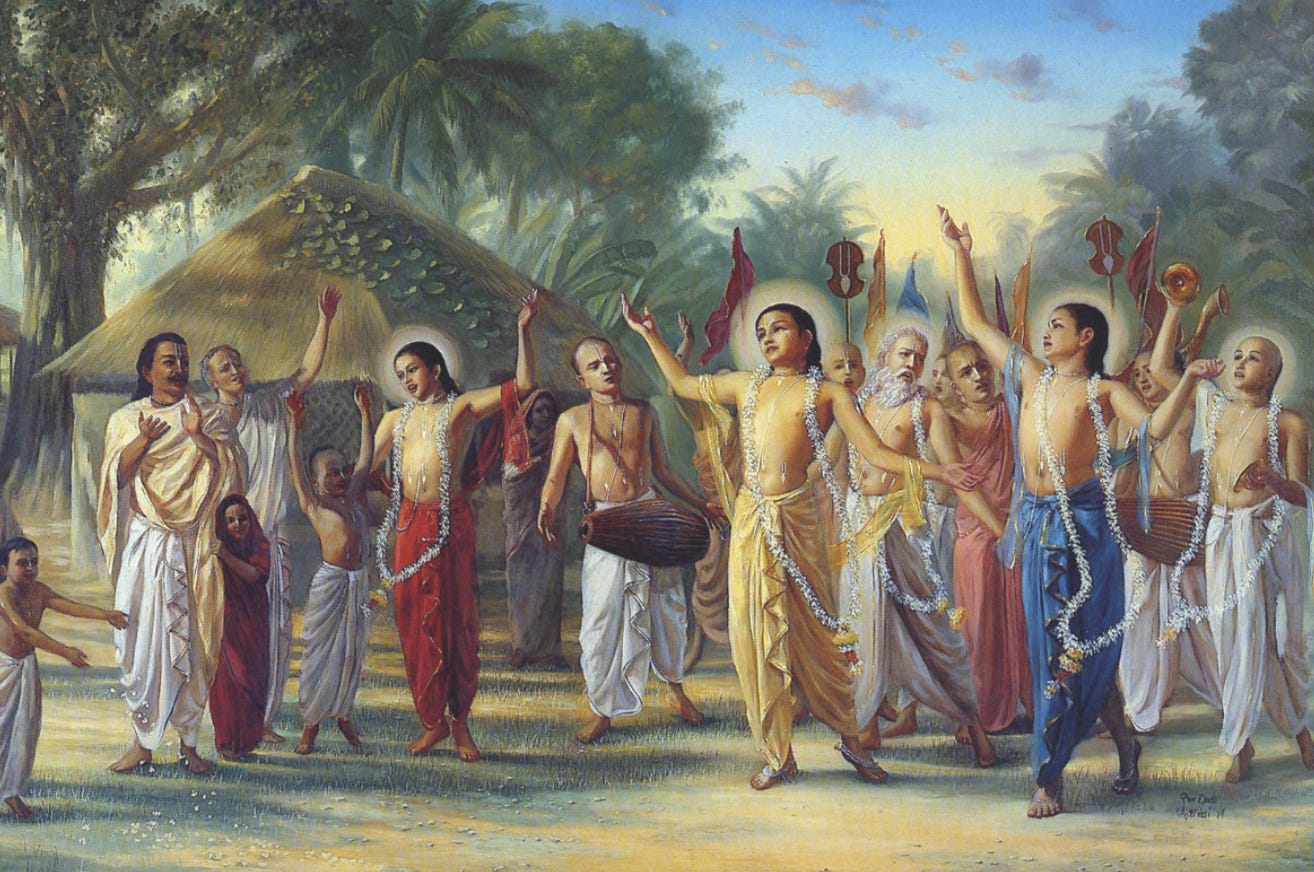
When the Raja of Puri first observed Śrī Caitanya’s group kirtan (saṅkīrtana) in the streets of the town, he was amazed. He had never witnessed that kind of kirtan, so full of love and ecstatic dancing. As he ruled over a city that hosted millions of pilgrims annually, he was well acquainted with a variety of spiritual practices. But this kirtan stood out. His brother-in-law Gopinatha said, “This is prema-kīrtana; it is the creation of Śrī Caitanya.”
